

Improving enterprise support through voice bots and conversational AI is transforming customer service by increasing speed, personalization, and overall experience, thus providing businesses with a significant competitive advantage.
But what exactly sets voice bots apart as a game-changing force in customer support? This guide breaks down how conversational AI voice assistants work, the clearest conversational AI use cases in customer service, a step-by-step implementation guide, real ROI data, and a live case study of AI voice bots deployed for after-hours lead capture.
What Are Voice Bots and Conversational AI Systems?
Conversational AI refers to any system that mimics human conversational patterns, able to interact through voice, text, or multi-modal interfaces. Within that category, voice bots (sometimes called voice-based chatbots) are conversational agents capable of understanding spoken language and responding instantly through phones, smart devices, or web widgets.
A conversational AI voice assistant takes this further by combining speech recognition with contextual memory, so it can carry a multi-turn conversation rather than just executing single commands.
Unlike legacy IVR-style systems, modern conversational AI systems draw on Natural Language Processing (NLP), Machine Learning (ML), and Large Language Models (LLMs), enabling them to understand context and intent beyond simple commands, personalize conversations by integrating with CRM and enterprise data, and continuously improve by learning from real interactions.
Voice Bots vs Chatbots vs Traditional IVR
Although the terms are often used interchangeably, voice bots, chatbots, and traditional IVR systems serve different purposes. Understanding these differences helps organizations choose the right solution for their customer service strategy.
| Feature | Voice Bots | Chatbots | Traditional IVR |
|---|---|---|---|
| Communication Channel | Voice conversations over phone or smart devices | Text-based conversations on websites, apps, or messaging platforms | Phone menus using keypad inputs |
| Interaction Style | Natural spoken conversations | Text-based conversations | Menu-driven navigation (Press 1, Press 2) |
| AI Capabilities | NLP, speech recognition, LLMs, contextual understanding | NLP, LLMs, contextual understanding | Rule-based with limited intelligence |
| Personalization | Retrieves customer information and personalizes responses through CRM integration | Personalizes responses using customer data and conversation history | Limited personalization |
| Typical Use Cases | Customer support, appointment scheduling, lead qualification, account inquiries | FAQs, order tracking, website support, customer self-service | Call routing and simple information requests |
| Human Escalation | Seamless transfer with conversation context | Seamless transfer with chat history | Basic call transfer with little context |
Which One Should You Choose?
Chatbots
Ideal for customers who prefer digital channels such as websites, mobile apps, and messaging platforms.
Voice bots
Better suited for phone-based interactions that require natural conversations, customer authentication, appointment scheduling, or CRM-driven support.
Traditional IVR
Remains useful for simple call routing but lacks the conversational capabilities, personalization, and automation offered by modern AI voice bots.
For many organizations, the best customer experience comes from combining voice bots, chatbots, and CRM integration into a unified omnichannel support strategy, allowing customers to move seamlessly across channels while maintaining context throughout the conversation.
Conversational AI Use Cases in Customer Service
Some of the clearest, highest-ROI conversational AI use cases include-
Order and account management
Customers check order status, cancel, or reschedule using natural voice commands.
Seasonal call-volume surges
Voice bots absorb overflow during peak periods without added headcount.
Outbound lead qualification
Bots pre-screen and route leads before a human ever picks up.
Identity verification
Routine document/ID checks are completed conversationally instead of through manual upload review.
How AI Voice Bots Improve Customer Service
Always-On Customer Support
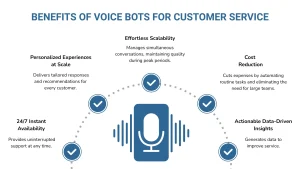
AI voice bots provide 24/7 assistance, enabling customers to receive instant support regardless of business hours or location. They can resolve routine inquiries, answer frequently asked questions, and capture after-hours leads, ensuring no customer request goes unanswered.
Faster, Scalable Customer Service
Voice bots can manage thousands of conversations simultaneously, reducing wait times and maintaining consistent service quality during peak demand. By automating repetitive inquiries such as order status, appointment scheduling, and billing questions, organizations improve response times while lowering operational costs. According to IBM, conversational AI can reduce cost per contact by 23.5%.
Automated Lead Qualification and Self-Service
Voice bots can answer inbound inquiries, ask qualifying questions, capture contact information, verify customer identity, and route requests to the appropriate team. This reduces manual effort while improving the customer experience.
Empowering Human Agents
By handling repetitive interactions, voice bots allow customer service teams to focus on complex issues that require empathy, judgment, or relationship building. When escalation is needed, the complete conversation history can be transferred to the agent, reducing repetition for customers.
Actionable Insights from Customer Conversations
Every interaction generates valuable operational data. Organizations can analyze customer sentiment, common inquiries, recurring issues, and workflow bottlenecks to continuously improve service delivery and business processes.
CRM-Driven Personalization
By integrating with CRM systems, voice bots can identify callers, retrieve customer history, reference previous interactions, and deliver personalized responses. They can also update customer records in real time, giving service teams a complete and up-to-date view of every interaction.
Implementation Guide: Deploying Voice Bots for Customer Service
Implementing voice bots into enterprise customer service requires a strategic, step-by-step approach to ensure smooth adoption and measurable impact.
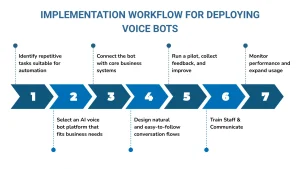
1. Identify High-Volume, Low-Complexity Use Cases
Start by mapping customer interactions that are frequent and repetitive, such as order tracking, account inquiries, appointment bookings, and FAQs. These are ideal for initial automation and deliver immediate ROI without disrupting core operations.
2. Choose the Right Voice AI Platform
Select an enterprise-ready platform with:
Autonomous & Integrated AI:
Makes business-aligned decisions and seamlessly connects with CRM, ERP, helpdesk, telephony, and omnichannel systems.
Secure & Compliant:
Adheres to GDPR, HIPAA, and ISO standards with robust audit trails.
Intelligent NLP & Escalation:
Processes language and sentiment in real time and ensures smooth handover to human agents with full context.
3. Integrate with Core Enterprise Systems
Ensure that APIs and out-of-the-box connectors for CRM, knowledge bases, and ticketing systems are properly configured. This enables bots to access customer data, update records, and log interactions in real time.
4. Design Intelligent Dialog Flows
Design conversation paths reflecting real customer journeys, using natural language, proactive prompts, fallback strategies, and escalation logic for complex interactions.
5. Pilot and Optimize
- Roll out to a pilot group or a specific department.
- Gather real-time analytics on metrics such as containment rate, FCR, CSAT, and escalation frequency, and analyze feedback to identify friction points.
- Continuously refine dialog flows, NLP training data, and escalation workflows.
6. Train Staff and Communicate Value
Educate customer service teams about AI escalation protocols, and ensure they can take over cases with full context. Inform customers about the new system to set correct expectations and encourage adoption.
7. Monitor Performance and Scale
Use centralized dashboards to track KPIs, automate reporting, and identify emerging patterns. As success is proven, expand to cover more use cases and channels.
Challenges in Implementing Voice Bots for Customer Service
Speech and Language Understanding
Despite advancements, understanding diverse accents, slang, and colloquial speech is difficult. Therefore, AI systems need comprehensive training on diverse datasets to perform accurately.
Integration Complexity
Seamlessly connecting voice bots with existing CRMs, telephony systems, and databases is technically challenging and thus requires robust APIs and coordination with IT teams.
Security and Compliance
Handling sensitive customer data demands rigorous adherence to regulations like GDPR and HIPAA, with encrypted data flows, privacy controls, and audit trails.
User Adoption and Trust
Both customers and employees may hesitate to embrace AI-powered support. Clear communication, transparent benefits, and consistent, accurate responses build trust over time.
Conversation Design and Human Escalation
Poorly designed dialogues and a lack of smooth escalation to human agents cause frustration. Intelligent fallback strategies and seamless handovers are critical for positive customer experiences.
Measuring ROI for Voice Bots in Customer Service
Implementing voice bots and conversational AI drives tangible ROI for enterprises, transforming contact center operations and unlocking new business value.
1. Cost Reduction
Voice bots automate high-volume tasks like account inquiries, FAQs, appointment scheduling, and order tracking, reducing labor costs and staffing needs. Automation can cut costs by 30–50% in contact centers, with a bot managing half of inbound requests, thus reducing staffing and saving significant costs annually.
2. Efficiency and Productivity
Conversational AI improves First Contact Resolution (FCR), reducing follow-up calls and average handling time (AHT). AI handles thousands of concurrent conversations, ensuring seamless operations during peak periods. Boosted efficiency lets agents focus on complex customer needs, increasing throughput and satisfaction.
3. Enhanced Customer Experience
- 24/7 availability of voice bots means no downtime, which increases customer satisfaction scores (CSAT) and Net Promoter Scores (NPS).
- AI-driven conversations reduce wait times and provide instant, accurate answers, helping to keep churn low and loyalty high.
- Personalization and sentiment analysis lead to more positive experiences, supporting lasting relationships.
4. Revenue Growth and Upsell Opportunities
By freeing up agents and analyzing customer interactions, voice AI can identify cross-sell/upsell moments, personalize product recommendations, and boost sales.
5. Scalability and Long-Term Value
AI solutions are highly scalable, handling fluctuating demand without adding headcount. Proactive service and predictive intelligence drive ongoing value well beyond the initial investment.
6. Data-Driven Insights
Conversational AI solutions collect and analyze data from every interaction, providing deep insights into customer needs, pain points, and service gaps—helping refine strategies and maximize ROI.
Real-World Example: AI Voice Bot for 24/7 Lead Management
A professional services client struggled with missed calls outside business hours, delayed lead follow-ups, manual qualification, and limited support for Spanish-speaking customers. These gaps resulted in lost opportunities and inconsistent customer experiences.
Nablasol implemented an AI-powered voice bot integrated with CRM, GoHighLevel, Twilio, and a conversational AI platform to automate the entire lead management process. The solution answered calls 24/7, qualified prospects in real time, scheduled appointments automatically, captured and transcribed caller information, and synchronized every interaction with the client’s CRM.
Results
- 100% lead capture during non-business hours with no missed opportunities.
- Automated lead qualification accelerated follow-up for high-intent prospects.
- Real-time appointment scheduling reduced delays in the sales process.
- Automatic CRM updates eliminated manual data entry and improved data accuracy.
- Natural bilingual (English and Spanish) conversations enhanced customer accessibility and experience.
This implementation enabled the client to deliver consistent, round-the-clock customer engagement while reducing manual effort and creating a scalable lead management process. Read the full case study
Conclusion: Human-Centric Digital Transformation
Voice bots are defining the future of customer service, enabling organizations to meet and surpass the relentless expectations of today’s digital consumer. With rapid digital transformation, enterprises that adopt voice automation and conversational intelligence gain a competitive edge. It delivers superior support, strengthens customer loyalty, unlocks new opportunities, and stands out in the market.
Ready to move from research to deployment? Nablasol’s conversational AI services help enterprises design, integrate, and scale voice bots tailored to their CRM and support workflows. Contact us to start your AI-powered customer service transformation.
FAQs
What technology do AI chatbots use to understand customer sentiment?
AI chatbots use real-time sentiment analysis powered by Natural Language Processing (NLP) and Machine Learning (ML) algorithms to detect customer emotions from text or speech, enabling them to respond empathetically and tailor interactions based on the user’s emotional state.
Can AI chatbots help retain customers impact of AI service quality on customer loyalty?
Yes, AI chatbots can significantly help retain customers by delivering instant, personalized support that increases satisfaction and loyalty. High-quality AI service leads to faster issue resolution, proactive engagement, and consistent experiences, all of which foster trust and reduce churn. Businesses using AI-driven customer service report higher retention rates due to enhanced personalization, predictive insights, and timely interventions that keep customers engaged and valued.
What is conversational AI for customer service?
Conversational AI for customer service is an advanced technology that uses Natural Language Processing (NLP), Machine Learning (ML), and Large Language Models (LLMs) to understand, interpret, and respond to customer queries in natural, human-like conversations via text or voice channels, providing instant, personalized, and scalable support around the clock.
How are AI chatbots improving customer service?
AI chatbots improve customer service by providing instant 24/7 support, reducing wait times, and handling routine queries efficiently. They personalize interactions using customer data, scale easily during peak demand, and offer multilingual support to broaden accessibility. AI chatbots also enable seamless escalation to human agents for complex issues and generate actionable insights to continually enhance service quality, resulting in higher customer satisfaction and agent productivity.
What are the most common conversational AI use cases in customer service?
The most common conversational AI use cases in customer service include order and account inquiries, appointment scheduling, outbound lead qualification, identity verification, and absorbing seasonal call surges. Enterprises typically start with high-volume, low-complexity use cases like order status checks before expanding to more complex, judgment-based interactions as the system proves reliable.