
CRM is moving beyond its traditional role as a system for storing customer records. In the coming years, AI, automation, and system integration are turning CRM into an intelligent operating layer that can surface insights, orchestrate workflows, and help teams act on customer data in real time.
CRM will undergo a major shift as AI and automation redefine how businesses connect with customers and run their operations. CRM will evolve from a passive system of record into an active growth partner, prioritizing seamless customer experiences and smarter, faster productivity. For business leaders, this shift directly impacts revenue growth, operational efficiency, and customer retention.
The Evolving CRM Landscape
CRM systems have long served as central hubs for customer data, but in the near future, that role will expand dramatically. Businesses no longer want tools that simply store information. They need platforms that anticipate needs, surface opportunities, and guide action.
Modern CRM now integrates across departments, providing a single, shared view of the customer and enabling seamless collaboration. This holistic approach ensures marketing, sales, and support teams collaborate effortlessly. As operations become more complex, CRM emerges as the backbone of customer-centric strategy, constantly adapting to real-time business demands.
Agentic AI and Predictive Intelligence
Gartner predicts that by the end of 2026, 40% of enterprise applications will include task-specific AI agents, up from less than 5% in 2025. For firms, that means CRM systems that continuously read behavioral, engagement, and billing signals to flag churn risk, forecast revenue, and recommend the next best action before a partner notices anything is wrong.
Picture a CRM that surfaces a long-standing client whose engagement activity has quietly dropped, or flags a prospect showing buying signals across your website and email before a competitor reaches them. Predictive lead scoring, renewal-risk forecasting, and revenue projections let firm leaders make faster, data-backed decisions instead of relying on the memory of whoever owns the relationship.
Hyper-Personalization Built Through Unified Client Data
According to Forrester, 75% of global business and technology professionals say improving customer experience is a high or critical priority for their CRM strategy. Personalization is about more than tailored marketing. It means giving teams the right client context at the right time, including their history, interactions, documents, service needs, and preferences.
That requires connecting data across the CRM, email, website, client portal, support, documents, billing, and marketing systems into a unified customer view. When these systems work together, AI can use that context to generate more relevant communications, identify client needs, and recommend the next best action.
AI doesn’t create personalization by itself; connected data makes personalization possible. For firms in regulated industries, this also requires appropriate privacy, access controls, and consent-based data use.
Hyperautomation of the Work That Drains Billable Hours
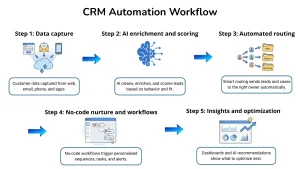
Hyperautomation combines robotic process automation with AI to eliminate the manual work that quietly drains professional capacity: data entry, intake routing, document collection, renewal reminders, and report generation. CRM will qualify and route new matters, chase missing client documents, and nurture prospects through intelligent sequences without constant oversight.
For instance, a tax practice can automate return-season intake and reminders; a law firm can automate conflict checks and engagement-letter workflows; a mortgage team can automate document follow-ups. The result is fewer errors, faster turnaround, and more of your experts’ time spent on billable, high-judgment work.
Conversational AI & Agentic Systems
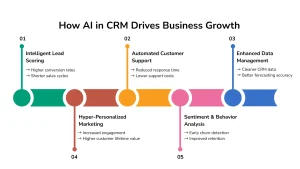
Conversational AI will enhance CRM further, using natural language processing for plain-language dashboard queries. AI-driven sentiment analysis reads between the lines of customer communications, alerting teams to dissatisfaction early. Sales teams will have access to customer histories during calls, enhancing responsiveness. Overall, AI transforms CRM from reactive tools into proactive advisors, reshaping daily workflows.
However, organizations must address AI bias and data quality risks, particularly in sentiment analysis and predictive scoring. Poorly trained models can reinforce incorrect assumptions, making governance and human oversight critical.
Voice and Omnichannel Integration
Voice interfaces and conversational AI are making CRM interactions more accessible and efficient. AI assistants can help teams retrieve customer information, update records, qualify leads, or access insights using natural-language voice commands. Voice bots can also handle routine customer inquiries across phone and digital channels, with complex interactions escalated to human agents.
The bigger trend, however, is connected omnichannel experiences. Customers may begin an interaction through a website, email, chat, social channel, or client portal and continue it over the phone without having to repeat their information. CRM integrations make this possible by keeping customer history and conversation context connected across channels.
Case Study: AI Voice Support for After-Hours Leads
A debt-resolution firm used a 24/7 bilingual AI voice agent to answer calls outside business hours, qualify prospects, capture lead details, and schedule appointments. By connecting the system with SugarCRM and scheduling tools, the firm converted previously missed calls into trackable, actionable opportunities while reducing manual follow-up work. Read the full case study.
AI Governance, Security and Compliance
As CRM systems handle more sensitive customer and client data, security, privacy, and AI governance become essential. Modern CRM environments need strong access controls, encryption, zero-trust security, and audit trails to ensure data is protected and every action can be tracked.
A well-governed CRM should combine secure data access, clear permissions, auditability, privacy controls, and human review. This allows firms to benefit from AI and automation without compromising client trust or compliance.
No-Code Customization and Integrations
No-code tools make CRM very flexible for the future. Drag-and-drop interfaces allow teams to customize dashboards, workflows, and reports without relying on developers.
Modern CRM platforms increasingly provide APIs, pre-built connectors, and low-code tools that make integrations easier to implement and maintain. However, connecting legacy systems, inconsistent data, and complex business workflows still requires careful architecture and governance. CRM connects smoothly with ERP, e-commerce, and marketing platforms, eliminating silos. CPQ extensions shine here, with no-code platforms integrating for custom quote-to-cash workflows in CRM ecosystems.
Vertical and Industry-Specific CRM
Industry-specific CRM solutions are gaining momentum as businesses look for platforms that reflect the workflows, regulations, and customer journeys of their industries. Healthcare, financial services, retail, manufacturing, and professional services, for example, have very different operational and compliance requirements.
These platforms can provide industry-specific workflows, data structures, integrations, reporting, and compliance capabilities that would otherwise require extensive customization.
However, vertical CRM isn’t automatically better than a flexible general-purpose platform. The right choice depends on the complexity of the business, existing technology stack, customization needs, and growth plans. For many organizations, a configurable CRM combined with the right integrations, automation, and AI capabilities can provide the flexibility needed without being tied to a narrowly defined industry platform.
Traditional CRM vs Modern CRM
| Aspect | Traditional CRM | Modern CRM |
|---|---|---|
| Core Role | A static system of record is mainly used for storing contacts and activities. | Intelligent operating layer that predicts needs, recommends next actions, and orchestrates workflows across teams. |
| Data Handling | Heavy manual data entry with fragmented customer information across tools. | Unified, real-time customer profile synced via ERP, marketing, and support integrations. |
| Automation | Basic rules and reminders with limited process automation. | AI-driven automation and hyperautomation handling lead scoring, routing, nurturing, and reporting end-to-end. |
| Personalization | One-size-fits-all campaigns with static customer segments. | Hyper-personalized journeys driven by behavioral, transactional, and contextual data across channels. |
| Intelligence | Descriptive reports and lagging KPIs. | Predictive and prescriptive insights, scenario simulations, and AI agents executing routine tasks autonomously. |
 Preparing Your CRM for the Future
 Preparing Your CRM for the Future
Preparing for the next generation of CRM doesn’t mean replacing your platform immediately. Start by understanding where your current system falls short, then strengthen the foundations that AI and automation depend on.
1. Audit your existing CRM
Identify what works, which processes remain manual, and where teams are relying on spreadsheets, email, or other tools outside the CRM.
2. Improve data quality
Clean duplicates, complete missing information, and standardize inconsistent fields before introducing advanced automation or AI.
3. Connect your systems
Integrate the CRM with ERP, finance, marketing, support, and document management systems to create a more complete and reliable customer view.
4. Identify automation opportunities
Start with repetitive, high-volume workflows such as data entry, lead routing, follow-ups, reporting, or document collection.
5. Introduce AI where it adds measurable value
Apply AI to practical use cases such as summaries, recommendations, forecasting, content generation, and task execution rather than adopting AI simply for its own sake.
6. Establish governance
Put appropriate security, permissions, human oversight, and AI quality controls in place as automation and AI become more deeply embedded in CRM workflows.
7. Measure outcomes
Track measurable improvements such as time saved, response times, conversion rates, retention, and overall operational efficiency.
Adapting to the Future of CRM
CRM is evolving from a system that primarily stores customer information into an intelligent operating layer that connects data, people, and workflows. AI-driven insights, automation, and system integrations can help businesses reduce manual work, respond faster, and deliver more consistent customer experiences.
But adopting AI is not simply about adding more technology. Businesses need clean and connected data, strong governance, appropriate human oversight, and workflows that teams can actually adopt. Over-automation can create poor experiences when human judgment is still needed, while disconnected systems can limit the value of even the most advanced AI capabilities.
The future of CRM is about building smarter, connected systems that work alongside people; automating repetitive work while giving teams the context and insights they need to make better decisions.
Transform Your CRM with Nablasol
Nablasol helps businesses connect CRM systems, integrate business data, and implement AI-driven workflows and automation tailored to their operations.
Book a free CRM assessment to identify where better integration, automation, and AI can improve efficiency and customer engagement.
FAQs
1. What are the most important CRM trends for 2027?
The most important trends include AI-driven automation, hyper-personalization based on unified customer data, and deeper integrations between CRM, ERP, and marketing platforms to support real-time customer journeys.
2. How will AI change day-to-day CRM operations for teams?
AI will take over repetitive work such as data entry, lead scoring, and follow-up scheduling, while conversational AI and intelligent agents will help teams query data in plain language and receive recommended next steps, improving both productivity and decision quality.
3. How should business leaders prepare their CRM for the coming years?
Leaders should invest in data quality, AI-ready infrastructure, and integration capabilities, while putting governance in place to manage AI bias, security, and compliance; this ensures CRM can act as a reliable, intelligent backbone rather than a disconnected database.