
In 2026, CRM will undergo a major shift as AI and automation redefine how businesses connect with customers and run their operations. CRM will evolve from a passive system of record into an active growth partner, prioritizing seamless customer experiences and smarter, faster productivity. For business leaders, this shift directly impacts revenue growth, operational efficiency, and customer retention.
The Evolving CRM Landscape
CRM systems have long served as central hubs for customer data, but by 2026, that role will expand dramatically. Businesses no longer want tools that simply store information. They need platforms that anticipate needs, surface opportunities, and guide action.
Modern CRM now integrates across departments, providing a single, shared view of the customer and enabling seamless collaboration. This holistic approach ensures marketing, sales, and support teams collaborate effortlessly. As operations become more complex, CRM emerges as the backbone of customer-centric strategy, constantly adapting to real-time business demands.
AI at the Core of CRM
Gartner predicts that by the end of 2026, 40% of enterprise applications will use AI agents for specific tasks. As digital change speeds up, these AI tools will do more than just help individuals. They will change how teams work together and make decisions.
Predictive Intelligence
AI-powered CRM systems will continuously evaluate behavioral, transactional, and engagement data to predict churn risk, forecast revenue, and recommend next-best actions. Instead of reacting to events after they happen, CRM systems will proactively surface opportunities and risks.
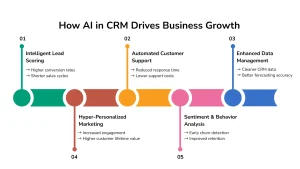
Picture a system that spots valuable leads before they are lost or suggests personalized outreach based on subtle customer signals. Predictive lead scoring, churn forecasting, and revenue projections will help leaders make faster, data-backed decisions with greater confidence.
Conversational AI & Agentic Systems
Conversational AIwill enhance CRM further, using natural language processing for plain-language dashboard queries. Voice commands and chatbots will resolve questions instantly across mobile apps and smart devices.
AI-driven sentiment analysis reads between the lines of customer communications, alerting teams to dissatisfaction early. Sales teams will have access to customer histories during calls, enhancing responsiveness. Overall, AI transforms CRM from reactive tools into proactive advisors, reshaping daily workflows.
However, organizations must address AI bias and data quality risks, particularly in sentiment analysis and predictive scoring. Poorly trained models can reinforce incorrect assumptions, making governance and human oversight critical.
Hyper-Personalization
Personalization reaches new heights in the near future, driven by CRM’s ability to unify data from every touchpoint. According to Forrester data, 75% of global business and technology professionals say that improving customer experience is a high or critical priority for their CRM strategy.
Customers expect tailored experiences, and CRM delivers by crafting unique journeys for each individual. Think dynamic content that adjusts based on browsing history, purchase patterns, or even social media activity. Marketing campaigns will become highly relevant, increasing engagement without being intrusive.
This level of personalization depends on real-time data processing. Emails, website visits, chats, and tickets flow into a single, continuously updated customer view. Businesses using these capabilities report higher engagement rates and improved customer lifetime value, as interactions feel timely and relevant.
Privacy remains essential, with CRM prioritizing consent-based data use to build trust alongside personalization. As a result, customers feel understood, fostering long-term relationships and repeat business.
Automation and Hyperautomation
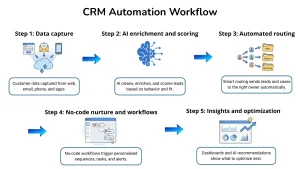
Hyperautomation is changing CRM by combining robotic process automation and AI to make everything more efficient. No-code platforms make these tools available to everyone.
Manual tasks such as data entry, lead routing, and report generation will be replaced by intelligent workflows. CRM will automatically qualify leads, assign them to the right reps, and nurture them through intelligent sequences, keeping pipelines moving without constant manual oversight.
No-code platforms democratize this power, letting non-technical users build custom automations. Marketing teams can design adaptive drip campaigns, while service desks automate ticket escalations. These capabilities cut costs, reduce errors, and accelerate decision-making, turning CRM into an operational engine rather than an administrative burden.
Voice and Omnichannel Integration
In the near future, voice interfaces are set to enhance the accessibility of CRM systems. Smart assistants integrated into CRM let users query data hands-free, ideal for on-the-go professionals. For example, “Show me top leads in US” will provide instant results with maps and contact details. Voice bots will also manage customer inquiries across phone, app, and web channels.
Omnichannel experiences will feel smooth and connected. A chat that starts on social media can move to email or a phone call without losing any details. While still emerging, early adoption of AR is already visible in mobile CRM apps, primarily for virtual product demos and assisted selling scenarios.
Enhanced Security and Compliance
As CRM manages more sensitive data, security becomes a built-in foundation. Zero-trust architectures verify every access attempt, while biometric authentication adds another layer of protection. Blockchain elements improve transparency in data sharing across partners and supply chains.
Blockchain-based audit trails are being explored in regulated industries to improve data transparency and traceability, though adoption remains selective rather than universal.
Compliance with global regulations like GDPR becomes automated and proactive, with CRM flagging risks before issues arise. Audit-ready logs track every action, giving businesses confidence and giving customers peace of mind. Secure CRM not only protects assets but also opens doors to innovative partnerships, as reliable data flows freely.
No-Code Customization and Integrations
No-code tools make CRM very flexible for the future. Drag-and-drop interfaces allow teams to customize dashboards, workflows, and reports without relying on developers.
Integrations become effortless. CRM connects smoothly with ERP, e-commerce, and marketing platforms, eliminating silos. CPQ extensions shine here, with no-code platforms integrating for custom quote-to-cash workflows in CRM ecosystems. This includes AI-OCR integrations for automated document processing, streamlining invoicing, and contract management. This composable approach ensures CRM scales alongside business growth.
Vertical and Industry-Specific CRM
Industry-specific CRM solutions gain momentum, offering built-in compliance, workflows, and benchmarks for sectors like healthcare, retail, and manufacturing. While general CRM platforms remain valuable, vertical solutions deliver faster ROI through ready-made features tailored to real-world industry needs.
Traditional CRM vs Modern CRM
| Aspect | Traditional CRM | Modern CRM |
|---|---|---|
| Core Role | A static system of record is mainly used for storing contacts and activities. | Intelligent operating layer that predicts needs, recommends next actions, and orchestrates workflows across teams. |
| Data Handling | Heavy manual data entry with fragmented customer information across tools. | Unified, real-time customer profile synced via ERP, marketing, and support integrations. |
| Automation | Basic rules and reminders with limited process automation. | AI-driven automation and hyperautomation handling lead scoring, routing, nurturing, and reporting end-to-end. |
| Personalization | One-size-fits-all campaigns with static customer segments. | Hyper-personalized journeys driven by behavioral, transactional, and contextual data across channels. |
| Intelligence | Descriptive reports and lagging KPIs. | Predictive and prescriptive insights, scenario simulations, and AI agents executing routine tasks autonomously. |
Adapting to Change
The role of CRM is evolving beyond that of a passive database or a tool focused solely on sales. It will function as an intelligent operating system for customer engagement.
Organizations that embrace AI-driven insights, hyperautomation, and no-code flexibility will move faster, operate leaner, and deliver more meaningful customer experiences.
While AI-led CRM brings huge gains, it also has guardrails leaders need to watch. Businesses must avoid over-automation that strips away human judgment and empathy in critical customer moments. They also need to manage data quality and integration complexity carefully, and invest in change management so teams actually trust, adopt, and effectively use the new AI-driven workflows.
The future of CRM is not about adopting more technology, but about building smarter systems that work quietly in the background while empowering people to do their best work.
Transform your CRM with Nablasol’s AI-driven, automated workflows tailored to your business. Reach out today to see how your CRM can accelerate growth and efficiency.
FAQs
1. What are the most important CRM trends for 2026?
The most important trends include AI-driven automation, hyper-personalization based on unified customer data, and deeper integrations between CRM, ERP, and marketing platforms to support real-time customer journeys.
2. How will AI change day-to-day CRM operations for teams?
AI will take over repetitive work such as data entry, lead scoring, and follow-up scheduling, while conversational AI and intelligent agents will help teams query data in plain language and receive recommended next steps, improving both productivity and decision quality.
3. How should business leaders prepare their CRM for the coming years?
Leaders should invest in data quality, AI-ready infrastructure, and integration capabilities, while putting governance in place to manage AI bias, security, and compliance; this ensures CRM can act as a reliable, intelligent backbone rather than a disconnected database.